E25 Tank Destroyer Build Log – Part 3

Photo-etch parts

Although the Trumpeter kit does come with some photo-etch parts for grilles and fenders, there are a couple of extra 3rd-party PE kits to go with it that add an even more dramatic level of detail.

For this kit, I’m using the Voyager Model PE kit, although I won’t be using everything from it.  A lot of the parts from the Voyager set are interior bits, like hatch hinges, tools that are kept inside the tank, and in particular an infrared telescope that is meant to be mounted on the side of an opened hatch.  My intention with this kit is to have it in buttoned-down mode hiding in trees and foliage, so a lot of the bits won’t be needed for that.
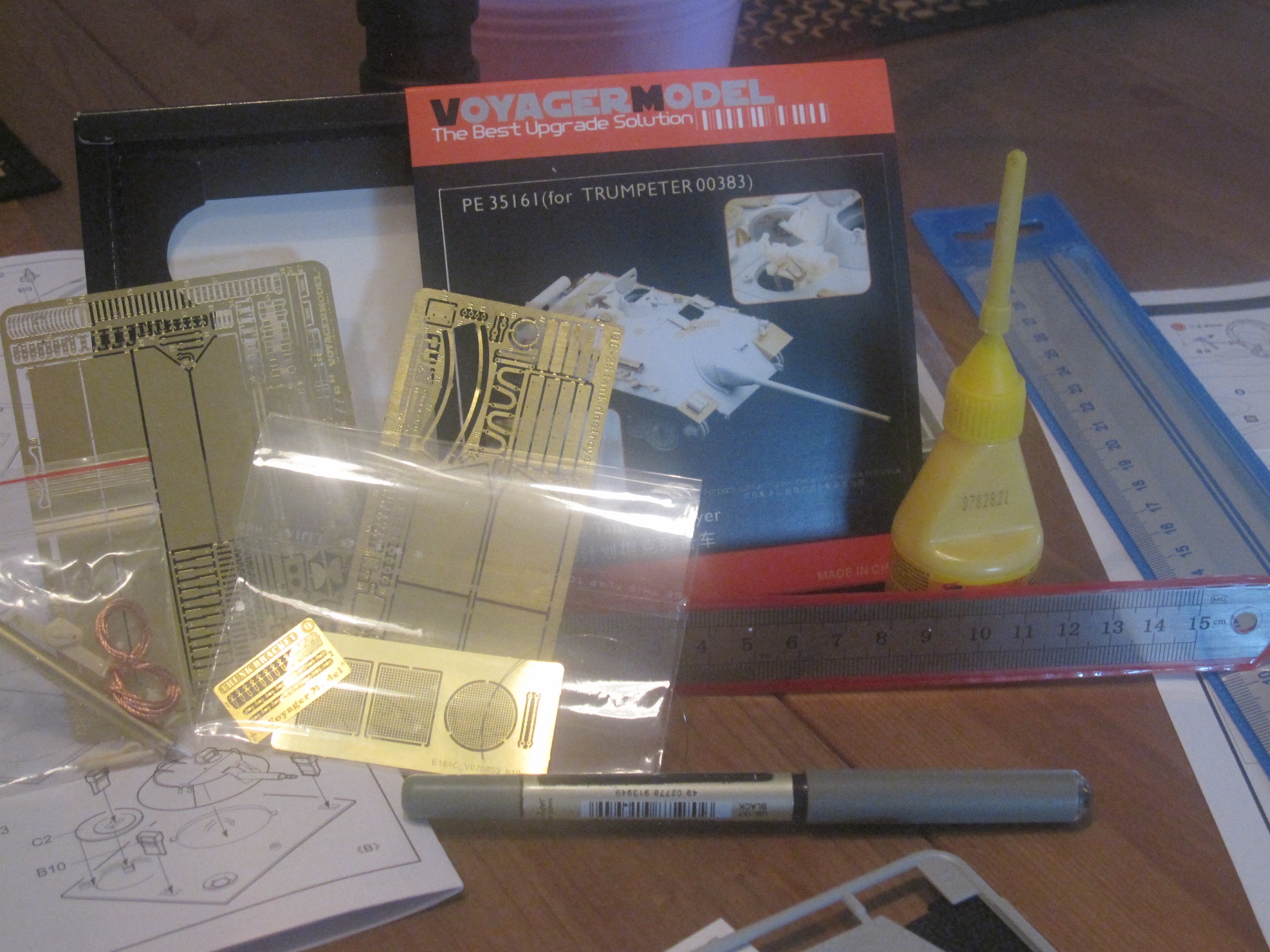
Notice the comparison items here to give you some sense of scale.  Click this image to see the full size version.

Notice the comparison items here to give you some sense of scale. Click this image to see the full size version.

A note about photo-etch:  some bits are REALLY f***ing small.  Look in this photograph – you’ll see some parts here are less than 1mm wide – some are basically 1.0 * 0.5 mm in size.  If you have big hands like mine, this is going to pose a major challenge, particularly since getting brass PE to stick to plastic requires super-glue (cyanoacrylate).  I’ve included some common items like a pen and a container of glue as well as a small cm ruler to give you some comparison.

That’s not to say you should just forego PE if you have big hands – on the contrary, I think it adds a great deal to a kit and can really take the beauty of a finished model “to the next level” (I cringe at writing that phrase).  Just be prepared to have a lot of patience with it.  Also, if you’re going to be working with it, have a clean mat clear of debris beneath your parts and if at all possible, a very dark drop-cloth beneath your seat.  A rather powerful flashlight will also come in handy (because you WILL drop a much-needed part the size of a grain of sand on the floor, and the better contrast you can build up, the easier it will be to find).

In the orange box is the chisel - I use a 1mm head, and the yellow-grip pliers are smooth-faced to hold parts while I file the rough edges away.

In the orange box is the chisel – I use a 1mm head, and the yellow-grip pliers are smooth-faced to hold parts while I file the rough edges away.

In addition, a smooth-face pair of pliers (most pliers have serrated or rough faces to give better traction, you don’t want that) are really useful for holding PE parts without marring them.  A tiny-headed model chisel is also recommended for removing parts from the center of PE sheets.

When you remove the parts, generally you want to press down on the part with one finger while you apply the chisel to the connector, and make a habit out of this.  Some parts it won’t matter, they’ll be big, but if you’re in the habit, then you won’t have tiny parts go flying away into who-knows-where when you separate their last connection to the main sheet.  When you do apply the chisel, make sure you are going after the connector at the point where it contacts the sheet.  If you hit it right at the join to the part, you’re likely to warp the part and give yourself a headache trying to smooth the part out before applying.  Instead, leave a bit of the connector on the part, and when you have it free, grip the part in your smooth-face pliers with the connector exposed completely and the part itself just barely extending out.  Then use a good file with quick, light strokes to file away the connector in a lateral direction (across the length of the part, not against its thin side – you don’t want to end up folding or crumpling the part with your filing).

Make sure to think ahead and decide in advance which items you want to do and which you don't - and cross out the ones you don't on the instructions.  As you complete items, check them off so you know where to go back to when you return.

Make sure to think ahead and decide in advance which items you want to do and which you don’t – and cross out the ones you don’t on the instructions. As you complete items, check them off so you know where to go back to when you return.

As you pick-and-choose which parts will look best on your model, cross them off the instruction sheet that comes with your PE kit so you’ll know what you’ve done and what you aren’t going to do.  I erred in this way and ended up building the infrared telescope from the Voyager kit – ooops.  Although once I was done I was pretty proud with having finished it, there went two hours which I could have spent doing other bits on the kit.

Twelve parts, two hours, and a small part of what's left of my sanity, gone away forever.

Twelve parts, two hours, and a small part of what’s left of my sanity, gone away forever.


Ready for grab-handles and schürzen mounts, all the plastic has been shaved and sanded away.

Ready for grab-handles and schürzen mounts, all the plastic has been shaved and sanded away.

Some parts will require to to carve off sections of the plastic molding on the original kit parts – for example, grab-handles and mounts for side armor (schürzen) in the PE kit look much nicer than the little nubs on the side of the hull of the original kit.  (Big note on this one – this is where PE kits end up adding a crap-ton of extra time in building a kit – there are fourteen grab-handles and twelve schürzen mounts, each one is a multi-part assembly.  If you just want to build a kit and paint it up nice and be done, this is the kind of part you probably want to skip.)  In order to mount them nicely, the existing molding will need to be removed.  I use a standard Xacto or other razor knife to shave off bits at a time, always gently (except when I forget and apply too much force).

Notice the tiny little brass bits on the bottom - those had to be CA-glued to the resin.  I had to include this pic, to justify my actually building this part.

Notice the tiny little brass bits on the bottom – those had to be CA-glued to the resin. I had to include this pic, to justify my actually building this part.

When you are shaving these bits off, as I just said – do it gently.  If possible, make sure that the entire blade is parallel with the hull, so the hull serves as a guide to get a clean removal.  Once you’re down to just a few little rises (you’ll feel them still), you can reverse the blade and drag it backwards over the remainder with some pressure, and this can remove those last stubborn bits that keep evading you.  Finally, use a 600-grit sandpaper to smooth things down.  You may also find that the removal process has left faint outlines of where the old elements were – this is a good thing, because that’s what will guide you on where to place the new PE parts!.

Because it's hard to build models when half your hand dangles like a zombie.

Because it’s hard to build models when half your hand dangles like a zombie.

Hey, did I mention you should go gently?  There’s two reasons for this, and they both have accidents as their point.  If you find yourself exerting any kind of significant force (and by “significant” I mean more than you would consider needed for cutting through a skinny little piece of plastic), something is about to happen.  That something is either the blade will slip free, or the part you are cutting will sever – in which case, you have a blade with a good bit of force behind it suddenly moving somewhere you didn’t expect.  Depending on the fulcrum of your grip, that somewhere is either going to be into the model, or into your off-hand.  Either way it’s going to make a mess of your model, either by putting a big gouge into it (repairable with putty, I hope), or a big blood-spatter onto it (generally washable, but gross).  You’ll also end up pissing yourself off, pissing off those who care about you, and if you’re really unlucky, you’ll entertain some ER doctor when you have to explain why (s)he is having to sew your thumb back on.

Okay, see you later, once I’ve done some more.


Posted in Build Log, Model Kits | Tagged , , , | Leave a comment

E25 Tank Destroyer Build Log – Part 2

Back again – sorry for the delay in posting, but our living room lamp blew out and I haven’t had an evening with sufficient light to do any work.

Tonight I’m going to be talking a bit about the suspension, some pre-painting on the wheels, and more about the roof options.

The Suspension

On the Trumpeter model, the suspension units for the E25 are pretty simple – they are three-piece elements (two sides and an end-cap) that end up looking deceptively similar.  As well, there are extra pieces on the sprues to make more suspension units – but only enough endcaps for the exact number – which initially threw me off as I ended up with too many for one side and not enough for the other, but once I discovered my error it was quick to remedy.  Fortunately I figured out what was up before the endcap’s glue set, so I was able to remove it and apply it to a new unit.

The assembled sides, minus endcap

The assembled sides, minus endcap

End-on view, showing axle extension

End-on view, showing axle extension

The first step of the kit instructions will have you building a total of twelve suspension units, and the second step will have you plugging them into the lower hull.  The instructions don’t, however, explain which ones go to which side (not really necessary, as they really only fit one way).  Just lay them out once assembled so that you have your six for left and six for right grouped properly.  It was also helpful for me to put them in order – each suspension unit has either a long or short axle extension, as the wheels will be interleaved with one another.  The one shown above is a long axle unit, with no endcap.  Once on the hull, they are placed in order long, short, long, short, long.


Once you plug them into the hull (and the pic below also shows some extra parts installed), it’ll look like this:

Note the placement of the axle extensions - long-short-long-short-long

Note the placement of the axle extensions – long-short-long-short-long

Wheels

I haven’t attached the wheels yet, probably will save them for late in the build, but I did pre-paint them on their sprue to go with the ambush camouflage I’ll be using.  Here’s how I went through it:

First, black primer.  Second, German armor yellow as a base color (I had a spray can of Flames of War “war paint” in the right color available, otherwise I’d have air-brushed them with middlestone or something similar.  Here’s the sprue with the base color:

German Armor Yellow, Done.

German Armor Yellow, Done.

Next step, I chose to keep two of the wheels on each side in the base color, so I masked two wheels and their hubcaps with standard masking tape.  After that, I decided I’d do two wheels on each side in green, so I hit the next four wheels and caps with German Green.

Green Wheels, Done.

Green Wheels, Done.

Lastly, I masked those off and hit the remaining two wheels and caps with a dark German Armor brown (pretty close to a chocolate brown).

Brown, Done.

Brown, Done.

I set the whole sprue aside, I’ll deal with it and the tracks later.

Roof Options

I was pretty sure early on that I’d be building a model with the machine-gun turret installed, but I went ahead and built both roofs (leaving off the unique parts for the one I was going to keep and use) just for completeness.  Conveniently, all the parts which are separate for the two options are kept on different sprues.

Each pair of options is found on a separate sprue, so if you know which you're going to be using, you can set the other aside.

Each pair of options is found on a separate sprue, so if you know which you’re going to be using, you can set the other aside.

For the non-turreted version, I discovered that it was pretty easy for me to make the mistake of assuming that everything was going to be sealed up – not so fast!  The main hatch is actually a double-hatch, and the smaller of the two is described in an open position in the instructions (for the record, if you want to build the kit in buttoned-down mode, the parts fit perfectly).

Roof Option 1 - with binos attached.  Note the messy rim around the hatches - I was too quick to act and glued them in buttoned-down mode before realizing the binos extended up through the smaller hatch.

Roof Option 1 – with binos attached. Note the messy rim around the hatches – I was too quick to act and glued them in buttoned-down mode before realizing the binos extended up through the smaller hatch.

This stuff is in step 9 of the instructions, and it’s the first part.  There are two pics of the roof, the left one is of the top and the right is of the bottom.  One tricky piece to assemble is the binoculars – the binocs are cast as being folded straight up, and they slot into a retaining bracket which will get glued up against the underside of the roof.

The Binoculars attached to their mounting bracket

The Binoculars attached to their mounting bracket

The mounting bracket for the binos glues to the underside of the roof, right next to the hatch.

Note the positioning of the binos relative to the hatches.

Note the positioning of the binos relative to the hatches.

Once attached this way, it can be difficult to find a way to place the piece somewhere that won’t deform the binos, but the corner of the box happens to be a perfect spot.

Just set it aside and let it dry a while.

Just set it aside and let it dry a while.

Unlike option 1, option 2 is a bit more straightforward.  The MG turret fits clean (though I did trim the retaining flanges a little bit to make it swivel a bit more easily), and all the bits are pretty easy.  I’ll push a few pics of it up on my next post.  I’m also starting in on some resin and photo-etch extras, so I’ll cover a couple of those on the next post too.

Posted in Build Log, Model Kits | Tagged , , , | 3 Comments

New Build Log: the Trumpeter E25 Tank Destroyer

Hi all –

Quick post today – last night I started the build on the E25 Tank Destroyer, as produced by Trumpeter.  I’ll post a quick update later tonight, but last night I did up the suspension units and some small lower-hull details.  I’ll take a photo and post that later too.

Meanwhile, here’s the original unboxing vid I did when I first bought the kit:

https://www.youtube.com/watch?v=RR_xQHQ5BSg

Posted in Build Log, Model Kits | Tagged , , , | Leave a comment

WE WON!

We came in first! I want to thank everyone for the votes, even though most of you don’t know me, it’s still great to get that upswell of support – very much appreciated, especially the strangers among you who just looked and said “Yeah, that’s cool!”

And in keeping with my own contest, I’ve just spent the last hour dorking around in MS Excel grabbing all the names of the “likes” and turning a random number generator loose on them to determine THE WINNERS of my own contest! (I’ve excluded my wife from the list – sorry honey, but I know you don’t want to play tanks anyway smile emoticon ).

AND THE WINNERS ARE….

In third place, winning an account bonus code for new players that includes 7 days Premium membership and 1000 in-game gold currency – Xiaonan Xu of Hangzhou, China

In second place, winning an account bonus code for new players that includes 7 days Premium membership and 1000 in-game gold currency – David LeBlanc who apparently is a member of the Canadian Forces

and in first place, winning an account bonus code for new players that includes 7 days Premium membership and 1000 in-game gold currency along with the German tier 4 premium heavy tank, the Panzer Kpfw. B2 740 (f) …

(wait for it)

drum roll

(wait for it)

Brian Post, of Tucson, Arizona!

Congrats to the winners, and once again thanks to everyone who voted! Helga (the Tiger) is most grateful as well, and we’ll see you all out on the battlefields!

(Winners of account and tank codes – you have been alerted via personal message on Facebook with your bonus codes, and if you need instruction on how to use them, just let me know and I’ll show you.)

Posted in Uncategorized | Leave a comment

Made it to the top 18 entries…

Well, my Tiger (build log previously entered) has made it past the judges and is now in the top 18 entries for voting – if you do like the thing, I’d appreciate it if you visit their FB image and throw me a “like” there :).


I’m going to turn this into a contest of my own:
With the model, it came with three bonus account codes, each of which has seven days’ premium and 1000 in-game “World of Tanks” gold currency. I will randomly select three people from among the “Likes” and give these codes away to those winners!

It also came with a bonus code for an in-game premium vehicle – if this model gets first place, I will also randomly award that to one of the three people who win the account codes.

So – good luck, everyone, and thanks for helping me!

Posted in Uncategorized | Leave a comment

Build Log: Italeri “World of Tanks” Tiger 1 Model – Final

Here’s Helga, all done up!  I still intend to go back some time and add some basing, but I haven’t figured out what kind of terrain to site her in.  Meanwhile, I hope you enjoy the pics (large versions are available by clicking on these).

Update:  here are the links for the remainder of the build log entries:

First Entry; Second Entry; Third Entry; Fourth Entry

Coming to a town near you!

Coming to a town near you!

View from the left, with the extra cable

View from the left, with the extra cable


From a slightly higher angle...

From a slightly higher angle…


A view of the wear around the tow cable

A view of the wear around the tow cable


A common spot for a tank like this to take a shot

A common spot for a tank like this to take a shot

Another "weak spot" people tend to aim at

Another “weak spot” people tend to aim at


A little view over the rear deck

A little view over the rear deck


A profile view

A profile view


A bit closer on that profile with more turret detail

A bit closer on that profile with more turret detail


Profile from the other side

Profile from the other side


A little more detail on the right of the turret

A little more detail on the right of the turret

All in all, I had a good time building and painting this up – it was a really fun assembly (and challenging where it needed to be, easy where I wanted it to be), and it looked great in the final.  Putting the weathering on was a breeze (even dusting over the decals came out really fine), and I was quite happy with how the ambush camo pattern worked out on it.

Wish me luck on the contest, and I’ll let you know when the next build log is going up!


Posted in Build Log, Model Kits | Tagged , , , , , | 1 Comment

Build Log: Italeri “World of Tanks” Tiger 1 Model – cont’d

Part 9

Approaching “done” status on the model itself – for the time being I’m going to leave the base very plain, but I’ll probably revisit it at some point to add some terrain and give the weathering on the tank a little more character relative to that basing.

Now, I’ve glued the gun into position (turret is left rotating), all the decals are in place, a matte coat has been applied, and I’ve used a couple of pigments for dusting and smoke effects (mostly around the mudguards and engine grilles, respectively).  While this finishes drying completely and I put on the final matte coat, I wanted to call your attention to a few details that you should be very careful of when doing your own version of this model.

Namely, the fragile stuff:

What a pain in the butt!

What a pain in the butt!

First off is the engine crank – it’s the long bar that mounts under the exhaust on the rear right of the hull, it’s a very thin piece whose end hangs down beneath the tow hitch.  I recommend not attaching this until you are almost done, as it extends down into space that your thumbs and fingers naturally want to travel while grasping the model.  Recipe for breakage.  I almost snapped it a few times myself.

Hatch handles and machinegun - handle with care

Hatch handles and machinegun – handle with care


Top machine gun – I’m 50/50 on whether to save it for the end.  I managed without any real close calls, but if you’re as clumsy as I can be sometimes, it might be worth saving for later.

Tracks – the two forward sections that mate the drive wheel with the top and bottom long pieces are particularly fragile and susceptible to pressure in the wrong places.  I broke them a couple times while manipulating the model.  Nothing fatal, they glue back fine, but better to be careful.

This is an ooops! waiting to happen

This is an ooops! waiting to happen

Headlamps – these are mounted on skinny little posts and are very easily snapped (I did snap one, and although they glue back pretty easy, I thought it looked better with one snapped off, added to the “used” look of the tank).

Hatch handles – there are two that I’m specifically thinking of, both on top of the turret.  Verrrry easily broken if you put your thumb in the wrong spot.

By the way – in the pic above the hatches on the turret are half-open.  This was intentional on my part, I wanted originally to make this model in the process of “blowing up” (which is probably the most accurate depiction of a Tiger 1 in WoT), but the model just came out too pretty for me to do it.  So later on I readjusted them and glued them down.  I’d recommend you choose one way and not change your mind, as it was a bit of a pain to get them mounted correctly afterwards.

Turret-locking flanges – on the bottom of the turret, there are two flanges that key into the lower hull through slots, and enable the turret to rotate while remaining securely level with the hull.  These are really too thin to be reliable, and getting the turret into the hull ends up requiring an alarming amount of pressure once you’ve finished painting.  Generally as a rule I feel that if you have to apply serious pressure to something, either you’ve done something wrong or the model casting isn’t quite right.

Next, a couple pointers if you’re going to try to do a completely accurate WoT version:

The following items were included in the instructions, but produce an inaccurate representation of the in-game model (however, they end up looking a little more cool, in my opinion).

Turret machinegun – leave it off.  Keep the mounting ring, but slice off the mount for the machinegun and don’t bother installing the gun itself.

Headlamps – in-game, the WoT Tiger has only one, mounted centrally, on a hanging mount that extends from the top front plate.

Turret side-hatches – there are two of these on the model in the instructions, both attach just forward of the rear cargo box.  In-game there’s only one, on the right side.  The model kit includes this hatch on the “D” sprue, but it’s covered with zimmerit, so you’d have to do some sort of putty filler to smooth it out.

Exhaust cowlings – in-game the model has rounded cowlings (on the “D-with-zimmerit” sprue), kit instructions lead you to the angular ones.  I personally really liked the angular ones, so went with those.

Long crow-bar – this is the really long bar that mounts just ahead of the turret ring.  Doesn’t exist in-game.

Bolt-cutters – just to the right side of the forward turret ring.  Don’t exist in-game.

That’s all I could spot.  Hope it helps, but like I said, I think it looks better the way the instructions said, but your mileage may vary.

Other entries in this build log: First Entry; Second Entry; Third Entry; Final

Posted in Build Log, Model Kits | Tagged , , , , , | Leave a comment

Build Log: Italeri “World of Tanks” Tiger 1 Model – cont’d

Part 6

Model with the dots applied

Model with the dots applied

Not a lot of action today, though it might look like it – I applied the “dots” of the ambush camo pattern today, and that’s likely to be it for the day.  I used middlestone and chocolate brown for the dots on the various bits.  Tomorrow I’ll apply some gunmetal to the machineguns and tool heads, beige or something similar to the tool handles, and most of my effort will then go to the tracks.  After that it’ll be weathering time.

I pulled out a beech cutting board I bought from a discount store which I’ll use as a base.  For now, it’ll be a plain-jane base and I’ll fix the model to it with a nail or two, but later I’ll go back and add some ground and proper vegetation.

That’s the news…more when I post it.

Part 7

Hi everyone, back again.

Equipment, guns, and weathering applied

Equipment, guns, and weathering applied

I tackled the tracks today, along with the details of tools and machineguns, highlighting, weathering, and putting some shell-holes on the commander’s cupola and forward machinegun port (traditional aiming spots for low-level TDs like Wolverines, etc.).  Bit of a pain in the butt to go over it with a metallic highlight, but I’m of the school of thought that says weathering of that sort should be hinted at rather than overblown (on 15mm scale, that is reversed or you lose it, but on 1:35, overdoing it makes the model look like a big turdnugget).  In-game, the Tiger has steel showing through on practically every corner or crease, and while that looks good in graphics, on a model it would come out gaudy and unrealistic.

A little gloss coat where decals are supposed to go makes a BIG difference

A little gloss coat where decals are supposed to go makes a BIG difference

I don’t have good pics of the tracks right now, mostly I was focused on the hull and turret, but I’ll shoot a few pics with the tracks visible when I get it on the base.  Meanwhile, notice the glare on the shot above?  That’s intentional – I’ve brushed on some gloss coat where the decals will go, tonight.  Gloss coat makes for a really smooth surface, and prevents air bubbles from staying behind your decal (which can result in “silvering”, where the film on which the decal sits shows up visibly – you want that to not appear at all, the decals should look as if they were painted on).

I also noticed something while picking out the decals from the sheet – as a whole, the decal sheet isn’t the best quality I’ve ever seen.  It’s workable, but the decals themselves look a little too fuzzy.  It’s possible that this was intentional, that they were printed “pre-weathered” to match in-game styles, but when I was looking at them initially I was feeling a little skeptical.  I’ll update again after I put them on tonight.

Part 8

All the decals are on - they look pretty good

All the decals are on – they look pretty good

All done with the decals – and I was wrong about them being bad, they were just designed with a little “pre-weathering” on them already.  They look just fine.

Other entries in this build log: First Entry; Second Entry; Fourth EntryFinal

Posted in Build Log, Model Kits, Uncategorized | Tagged , , , , , | Leave a comment

Build Log: Italeri “World of Tanks” Tiger 1 Model – cont’d

Part 3

Using tack paste, we cover the spots on the hull that we want to remain yellow

Using tack paste, we cover the spots on the hull that we want to remain yellow

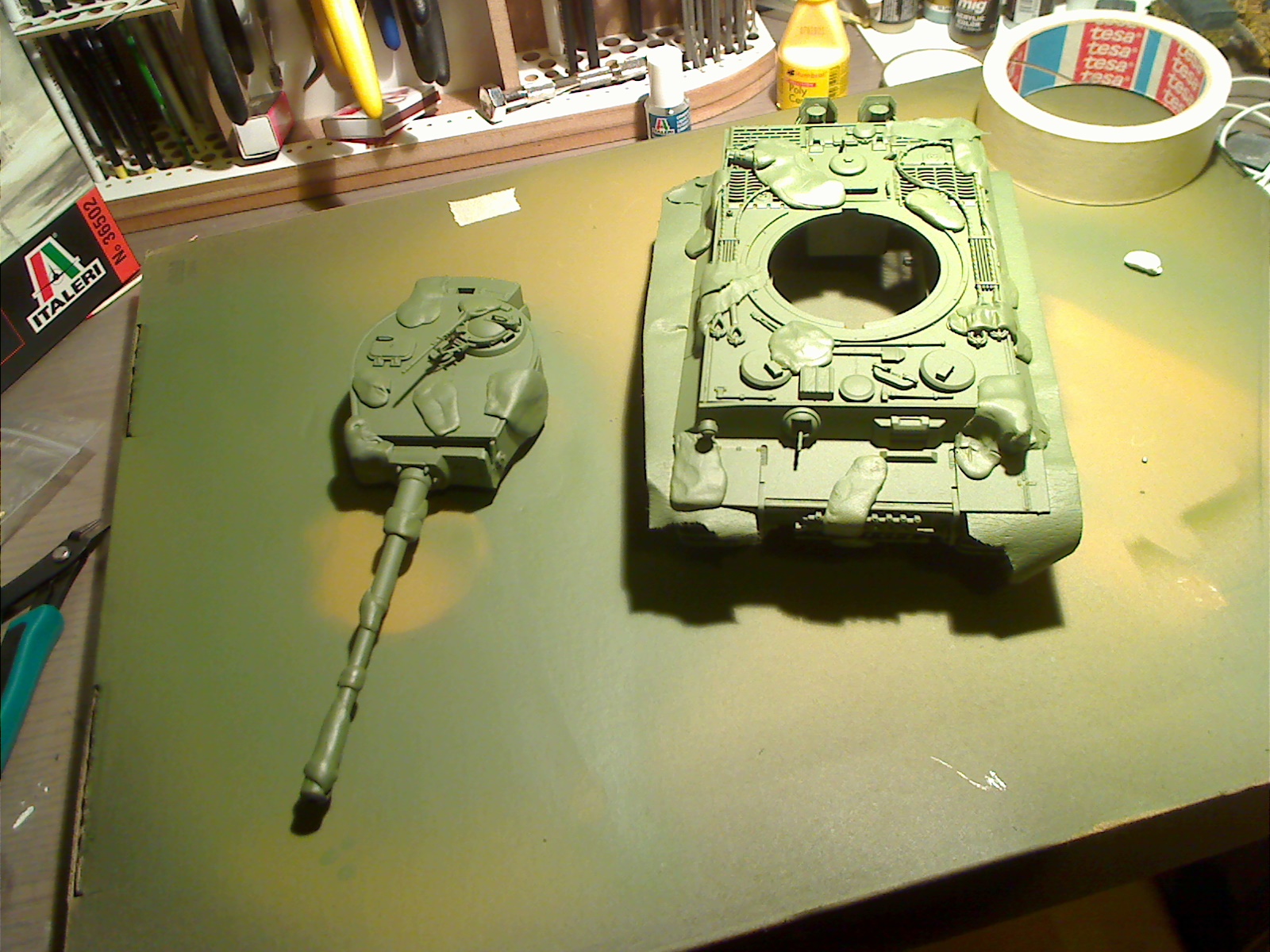
Today’s operation was pretty simple – I used tack paste (Brits call it “blue tack”, don’t remember a US analog for this stuff – it’s basically a gum paste that people use to stick posters and things to walls) as a masking element with a bit of regular masking tape to help out here.

My local version of tack paste.

My local version of tack paste.

Almost any kind of tack paste works, the stuff I get seems pretty specific to Germany, but you’ll find similar all over the world.  The principle is that where I put the mask, the model remains the original sand yellow color.  So once I had the tack where I wanted it, I sprayed the whole thing with the next color in line – German Army green.  Flames of War folks know this stuff as “reflective green,” and this is close, but it’s a genuine army paint here.

Tack paste masking on the turret

Tack paste masking on the turret

Tomorrow this stuff will have dried completely, and I’ll add more tack and tape to cover up about half of the remaining exposed space, and then hit it with a full coat of German Army brown.  After that’s dried, I’ll peel off the tack & tape, and I’ll be left with the tank in three-tone base for its camouflage.  After that it’ll be a matter of adding spots (traditional German ambush-camo had contrasting spots, and the WoT version was much the same).  Although the original “real life” versions also had the track wheels done up, in WoT the wheels were armor gray, so I’ll hit them up with that after masking away the rest of the hull to avoid spillage.

Then it’ll be time for a few details, like metallics on the machine gun, and some track details – then scarring and weathering for the whole thing.

Part 4

Fresh tack and tape applied

Fresh tack and tape applied

Okay, I’ve applied more tack and a lot more masking tape to the hull and turret, now that the green has had a chance to dry.  I use a lot more masking tape now, because the job at this stage is to break up the large areas, and preserve some spaces that will remain green.  Since now there’s a pattern beginning to build up, masking tape works as a “bridge” between areas of tack, and the extra tack is only really needed in spaces where the tape is too big or threatens surface detail.

I have to note here, artists call this work “negative space” – since what I’m doing is technically preserving a color rather than applying a new one (though I’m also doing that).  I find this one of the hardest parts of modeling for me to wrap my brain around.  I’ve been doing progressive layers upon layers in the past, and it’s very hard for me to grok the concept of picturing how the model will look after applying the next coat.

Fresh tack and tape applied

Fresh tack and tape applied

Now that this stuff is on, I’ll hit the wheels up first with a coat of light grey (to match what’s in the game).  After that’s had a chance to dry, the armor brown will go on over the rest, and then that’ll be given some time to dry before peeling off the masks.

One note on the “blue tack” crap – that stuff is re-usable.  Even after you spray paint it, you can still ball it up and it’ll retain its tacky nature, so you can use it again and again and again.  Eventually it’ll lose its ability to cling, but that’s a long while out, and if this model goes well I intend to do similar jobs to a bunch of my 15mm-scale Flames of War Germans.

And maybe to that E25 that’s been sitting on my shelf for a verrrry long time, begging me to paint it in action!

Part 3

Alright, the tape and tack are off – and it looks pretty good!

One note – when removing tack from your own models, be very careful with and around delicate parts.  This stuff can be hard to peel off, and it might take handles, antennae, or headlights with it.  Also, some brands can be a lot more “gluey” than others, and hard to pull away.  If you experience this problem, ball up some of the tack and use it to pat on the stuff still attached to the model.  Repeated patting will get the stuff to stick to itself, and you’ll peel it off the model without too much trouble.

All the tape and tack are off

All the tape and tack are off

Other entries in this build log:  First Entry; Third Entry; Fourth EntryFinal

Posted in Build Log, Model Kits | Tagged , , , , , | 2 Comments

Build Log: Italeri “World of Tanks” Tiger 1 Model

I picked up one of these models to participate in the WoT contest coming up, and figured I’d keep a build log as I went along – so if you like building models or just want to see some of the basics of how it’s accomplished, read on :).

PART 1:

Alright – I won’t bore you with the individual parts step-by-step of assembly, but I will give you a broad overview and a tools list for it.

Sprues – generally the parts sprues were pretty clean, very little flash, and fit was very good.  The model from which this one was drawn has obviously gone through a few generations, and we’re seeing the benefits of that.

One thing I didn’t notice at first:  there are TWO “D” sprues.  One with the original zimmerit Tiger parts, and one with the clean-sides WoT parts.  They have a lot of overlap in parts, but the original zimmerit sprue contains some elements that are not duplicated.  Italeri fortunately calls out the WoT-specific stuff with red highlighting in the instructions, but I didn’t really understand that until I was a good way in.  Didn’t cause me any problems, just a little anxiety when thinking that I had some missing bits.

Decals – some good memorable WoT items there, which I’ll use on my build.  No decals from the original Tiger model are here, so if you’re looking to use this kit as an authentic-style WW2 model, prepare for that.

Tools – in the build process, I kept my tool set pretty limited, since most people playing WoT won’t have a full bench like I do.  Here’s all I used during assembly:

  • Wire cutters (for snipping pieces off of sprues)
  • One set standard tweezers
  • One set spring-shut tweezers
  • One triangular-section file
  • One hobby razor knife
  • One pin-vice (the hand-held drill – I actually grabbed two when I started, but in the end only used the smaller bit, so one is all you need)
  • Glue from the kit (very thin with a brush applicator – particularly useful when putting tracks together, and for areas where the glue will “wick” up a seam while you hold it together with the other hand)
  • Humbrol poly cement (any brand will do, this one has a long metal tip for reaching tough spots, and I find this thicker form of cement is a little stronger than most brush-on varieties)
  • Two sheets white A4 printer paper (these sat under the model and under sprues – helps to keep an eye on tiny parts, makes cleanup of extra gunk easy, and keeps the wife from yelling at me if I spill glue)
Tools for the Tiger 1 build

Tools for the Tiger 1 build

Although there are many parts, most go together without any trouble at all.  The tracks will be the primary challenge of assembly (some sections need to be put together one link at a time, then formed to the wheels while the glue is still moldable – see the Italeri website, they have a good video demonstrating how to handle these).  If you put them together on a hard, flat surface, you can string 6-10 of them together before sliding them into position over the wheels.  The second-hardest assembly task is installing handles – these tiny little bits are really hard for me, because my hands aren’t as steady as they used to be.


Assembly completed

Assembly completed

Still and all, I got it done in four sessions of about 2-3 hours each while watching TV with my wife.  You can probably move faster than me.  I would have done it quicker, but two of those sessions were assembling tracks, and I didn’t want to turn the hull over onto a track that was still drying.  Safer to let it cure for a few hours or overnight, then do the other side.

I originally wanted to go with a “blown-up” vehicle, since that’s what Tigers are best at in WoT, but after completing it I decided it was just a little too pretty for that.  So instead it’ll get a camo job and a decent basing done before finishing.  I’ll still give it some battle-damage (some gashes, maybe a hole or two from a pesky E25 or Sherman), but the overall tank will remain intact.

One thing to note:  the instructions include a cupola machine-gun as part of the install.  This isn’t part of the in-game tank, if that’s what you’re really after.  I put it on because it looks cool.  Your mileage may vary.

Primer coated in matte black

Primer coated in matte black

After assembly, I primed it up with matte black all over.  (For reference, I use an acetone-thinned primer here, but I don’t have much preference.)  This helps to create shade effects as the black tends to give more depth beneath the surface paint job.  It’ll also make scratches look a bit more real and provide some good interior shadow.  The objective here is to look good for a camera, and for an observer approximately 1 meter away.


PART 2:


A handy bit of domestic larceny to help out with Helga the Tiger here

A handy bit of domestic larceny to help out with Helga the Tiger here

A quick update here – after the primer is completely dry (I leave it for 24 hours, probably not necessary to wait quite that long), I stole some of my wife’s hairspray and gave the model a good coat all over.  You can probably use el-cheapo stuff from the drugstore if you don’t have any handy in the house.  Really, any kind of hairspray will do the trick just fine.  Apply it and let it dry completely.  If you’re doing it on your workbench, make sure to stick a sheet of paper or something in between where your model is and any sensitive surfaces like magnifiers, electrical equipment, etc., or that stuff will get a coat of it on it as well.

The objective here is to give me a water-soluble base on top of my primer (which is *not* water-soluble), which will wait under my hull coat for when I’m almost done painting.  At that point, I’ll get a q-tip (you brits call them ear buds or something), soak it in water, and wet down edges and spots where crew would walk, then use the dry end or a toothpick (cocktail stick) to scrape away tiny little chips of the hull paint to give it some wear-and-tear look.  I’ll let this dry tonight, and tomorrow I’ll slap on the base hull color of a dark sandy yellow (not taxicab yellow, but more of a summer wood kind – WW2 fans will recognize it, it’s often referred to as “dunkelgelb” or “German yellow” among modelers).  Once that gets dry, I’ll mask off some sections and start developing the camo pattern.

Links to other entries:   Second Entry; Third Entry; Fourth Entry; Final

Posted in Build Log, Model Kits, Uncategorized | Tagged , , , | 2 Comments